
Looking at the River Wye today it is hard to imagine that the nine miles of river between High Wycombe and Bourne End once powered over 30 mill wheels, twenty of which were listed in the Domesday Book of 1086. Most of these started as corn mills and were a crucial factor behind the growth of High Wycombe but by the seventeenth century the majority of them had reverted to rag based paper making. The paper mills were temporarily closed in 1636 amidst fears that the rags were spreading plague.
By 1815 mill numbers had increased to 34 and in the late 1820’s the introduction of the Fourdrinier Machine caused handmade paper production to become redundant. This development in turn unfortunately made the paper mills a target for the machine breakers riots in 1830.
Download the full article by clicking on the button below. It will open in a new window. Close it to return to here.
Search Terms
Blotting On The Landscape
Looking at the River Wye today it is hard to imagine that the nine miles of river between High Wycombe and Bourne End once powered over 30 mill wheels, twenty of which were listed in the Domesday Book of 1086. Most of these started as corn mills and were a crucial factor behind the growth of High Wycombe but by the seventeenth century the majority of them had reverted to rag based paper making. The paper mills were temporarily closed in 1636 amidst fears that the rags were spreading plague.
By 1815 mill numbers had increased to 34 and in the late 1820’s the introduction of the Fourdrinier Machine caused handmade paper production to become redundant. This development in turn unfortunately made the paper mills a target for the machine breakers riots in 1830.
Of the five mills once based in Loudwater the most productive was Snakeley’s, or Fords Blotting Mill as it was better known, in Boundary Road pictured above. A mill was first recorded on this site as early as 1670 but production really only reached its peak after Thomas Burch Ford purchased the mill in 1878 for £6,150.
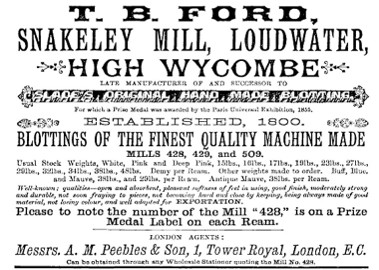
Ford’s blotting paper became world famous and over the coming years it became a huge enterprise. Not only blotting paper was produced as the mill also made pharmaceutical products and filtration mats used in bottling beer and wine.
advert from 1882
In 1898 the Fords laid on a water system for Flackwell Heath and in 1931 they diversified and began marketing the popular best selling Ford Patent Fountain Pen, although the pen was not manufactured or even assembled at the Loudwater premises.
By 1959 Fords was the only rag paper mill left but continued to prosper on the strength of the world demand for blotting paper. The subsequent drop in popularity of ink pens and introduction of word processors caused a corresponding drop in blotting paper demand and the company was forced to cease production in 1970.
The mill site was demolished in 1976 and the chimney dynamited the following year. All that remains is the original mill house now called Snakeley House which is currently the company premises of the Fish Partnership.