
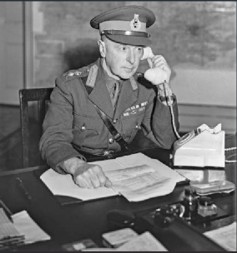
General Sir Frederick Alfred Pile was born in Dublin on 14th September 1884. He was a Senior British Army Officer who served in both world wars. Early in WW1 he was a Staff Captain in the 1st Division before becoming a Brigade Major with the 40th Division in 1916 after getting married in 1915. In the closing stages of the war he became a General Staff Officer with the 22nd Corps in France. During the war he was awarded the Military Cross and the Distinguished Service Order.
Download the full article by clicking on the button below. It will open in a new window. Close it to return to here.
Search Terms
Sir Frederick Pile
General Sir Frederick Alfred Pile was born in Dublin on 14th September 1884. He was a Senior British Army Officer who served in both world wars. Early in WW1 he was a Staff Captain in the 1st Division before becoming a Brigade Major with the 40th Division in 1916 after getting married in 1915. In the closing stages of the war he became a General Staff Officer with the 22nd Corps in France. During the war he was awarded the Military Cross and the Distinguished Service Order.
He was transferred to the Royal Tank Regiment in 1923 and promoted to Major. In 1928 he became Commander of the 1st Experimental Mechanisation Force and Assistant Director of Mechanisation at the War Office. In 1937 he became General Officer commanding the 1st Anti Aircraft Division. Before WWII even started he foresaw the likely pressure on male personnel and investigated whether women would be capable of taking part with anti-aircraft batteries. After consulting Caroline Haslett of the Women’s Engineering Society to observe the work of a battery in Surrey she advised him that women would certainly be able to take on the work.
At the outbreak of WWII Sir Frederick was promoted to General Officer Commander-in-Chief of Anti-Aircraft Command, a position he held throughout the war, and he was the only British General to retain the same command throughout the war.
Office working in 1942
He was tasked with directing the network of search lights and anti-aircraft guns and rocket launchers. He oversaw the defence of Britain including the Blitz in 1940/41 and combatting the menace of the German V weapons of the V1 flying bombs and V2 rockets during 1944 and 1945.
Watching an anti-aircraft rocket
launcher in March 1944
As mentioned earlier, he overcame the shortage of manpower with the successful integration of over 74,000 women of the Auxiliary Territorial Service into his command.
Earlier in 1937 the White House, formerly known as Hillcrest, on Heath End Road in Flackwell Heath had been purchased by Hester Melba Pile, the second wife of Sir Frederick. It was considered to be a safe retreat from the WWII London bombing and both Sir Frederick, Hester and their maid Nellie Payne made much use of the house throughout the war. Various other establishments requisitioned for the war effort were reasonably close, such as Hughenden Manor, Danesfield House, Walters Ash air base, Wilton Park, where Sir Frederick was aware of the work, and Prime Minister’s Chequers. Although Hester and Nellie preferred to stay in London, they often travelled to the White House to be away from the constant threat of heavy bombing. Sir Frederick and Hester were members of Flackwell Heath Golf Club and supported village events when they could. Frederick took on the Presidency of the Flackwell Heath Home-Coming Forces fund.
The White House
After the war Sir Frederick produced the book ‘Ack-Ack: Btitain’s Defence Against Air Attack During The Second World War’. He was created a Knight Grand Cross of the Order of the Bath in the 1945 New Year Honours. He then became Director General of Housing with the Ministry Works and he was also Commander of the Royal Artillery until 1952. He married his third wife in 1952 and sadly died on 14th November 1976 aged 92.
The steam locomotive Southern Railway Battle of Britain class No. 34058 ‘Sir Frederick Pile’ was introduced in April 1947, withdrawn in October 1964 and stored until it is still currently being rebuilt.
John Gurney, assisted by information from Sally Scagell.