
One of the disadvantages of living on the ridge for the villagers of Flackwell Heath in the early days was the lack of amenities compared to living in the valley, in particular fresh water and mains drainage. As the population grew towards the latter part of the 19th century, the availability of fresh water was a constant source of worry and anxiety to the residents of the village. Most of the villagers relied entirely on the many wells and springs which were abundant on the ridge due to its geological features with a high water table enabling water to be discovered at a depth of only eleven feet. The most popular springs were at Black Ridge, White Pit and Spring Lane.
Download the full article by clicking on the button below. It will open in a new window. Close it to return to here.
Search Terms
LIQUID ASSET
One of the disadvantages of living on the ridge for the villagers of Flackwell Heath in the early days was the lack of amenities compared to living in the valley, in particular fresh water and mains drainage. As the population grew towards the latter part of the 19th century, the availability of fresh water was a constant source of worry and anxiety to the residents of the village.
Most of the villagers relied entirely on the many wells and springs which were abundant on the ridge due to its geological features with a high water table enabling water to be discovered at a depth of only eleven feet. The most popular springs were at Black Ridge, White Pit and Spring Lane. Collecting enough fresh water from springs was a lengthy and arduous task. Strategically placed guttering to channel rainwater into large barrels or tubs was a less physically demanding option and, as a last resort, the children were sometimes sent down the hill to collect water from the river in buckets. The lack of a main sewer system meant that pits, buckets and cesspits were the only and very unhygienic means of servicing the toilet which in most cases was located at the bottom of the garden and shared by two or more families.
In October 1893 it was joyously reported in the South Bucks Standard that ‘An ample supply of bright good water is now being continuously pumped into two large tanks provided at convenient centres in Flackwell Heath. This was made possible through the generous help of Mr Frederick T Ford (owner of Snakeley Mill) aided by many willing subscribers’. The cost of the tanks and pipes was £116.
A later edition which commended his efforts
The water was pumped up from Ford’s Mill in Loudwater through pipes laid beneath Treadaway Hill into two cisterns, one on the Common close to where the war memorial is now and a second in Heath End Road near where the Veterinary Surgery is now. Drawing water from the one on the Common was more popular amongst the villagers as it was guarded by a nearby resident. The one at Heath End Road had lower sides and unfortunately became the target of vandals (yes, even in those days!) who would place frogs, dead birds and other unmentionables into it.
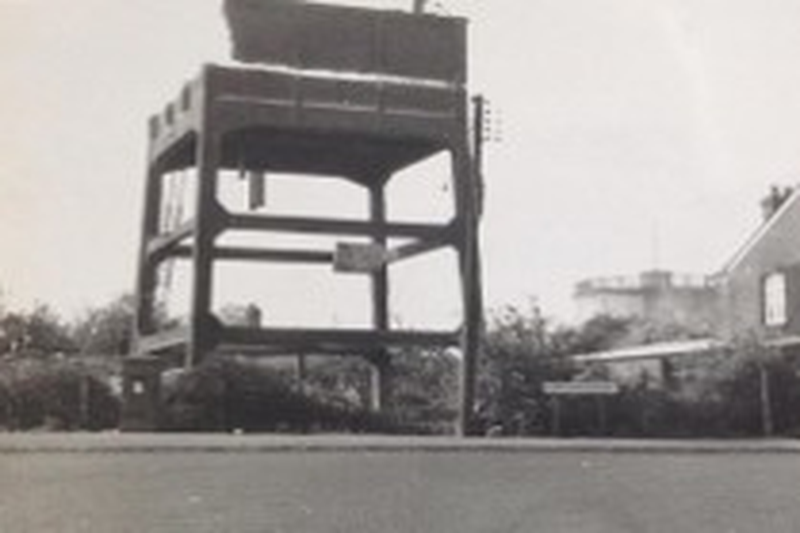
The ‘old’ tower shortly before demolition in the 1950’s with the ‘new’ tower in the background.
The first company water supply was pumped up from Bourne End in 1910 and a water tower was erected by the crossroads at Northern Woods to assist and improve the supply. During the First World War the local boy scouts group guarded the tower for a while to watch for German agents who may have been intent on poisoning the village water supply but none appeared. Despite the long overdue improvements to the water supply, stand pipes at various locations in the village remained in use until 1926. By the 1930’s the local authorities at last seemed to have taken an interest in the lack of amenities to the village and mains sewerage and electricity were also supplied. The ‘new’ water tower was erected in Georges Drive in the 1950’s before the old one was demolished.
Current water tower in Georges Drive
The current tower has not been without its problems and, in October 2011, the Bucks Free Press reported that several homes close to the tower were lucky to avoid flooding after thousands of litres of water overflowed from the tower and rushed along the surrounding roads. Fortunately the roadside drains were able to cope but it was an incredible waste of water. A spokesman for Thames Water commented at the time that there had been a temporary problem with the tower control system but that it had not impacted on water supplies.
So the current residents of Flackwell Heath should be grateful that these days a hosepipe ban is their only water problem.
John Gurney, for and on behalf of the Flackwell Local Area History Group.